SENTETIA
1
“Day and night, you could hear the sea crashing through the walls and crashing through the words.”
- Marguerite Duras, Blue Eyes, Black Hair

Place and event, as architect Christopher Alexander wrote, are like a riverbed and flowing water, continually shaping one another. The character of a place emerges through the patterns of life that continuously unfold within it.
At Pallas, the benches, shelves, and ledges are built from wood that lay stacked atop a concrete pad on the Inverness Ridge for 15 years. Douglas Fir that came from a forest that burned in the 1995 Mount Vision Fire in Point Reyes. Dried by the blaze and milled on the ashen hillside, the wood cured as the Bishop Pine cones began incubating the successive forest.
The pad was to be the floor of a studio designed by Daniel Liebermann, the esoteric and visionary organic architect and former apprentice of Frank Lloyd Wright; it was to be part of his final project—a center for the study of ecological habitats. Today, the ellipse of powdered rock remains open to the sky. A fireplace of brick and stone gapes between cinderblocks; grass grows through the holes intended for a line of interior trees. At the center, a rusted, 20-foot-tall steel gyre awaits ceiling beams while serving as a toy structure for a litter of baby foxes.
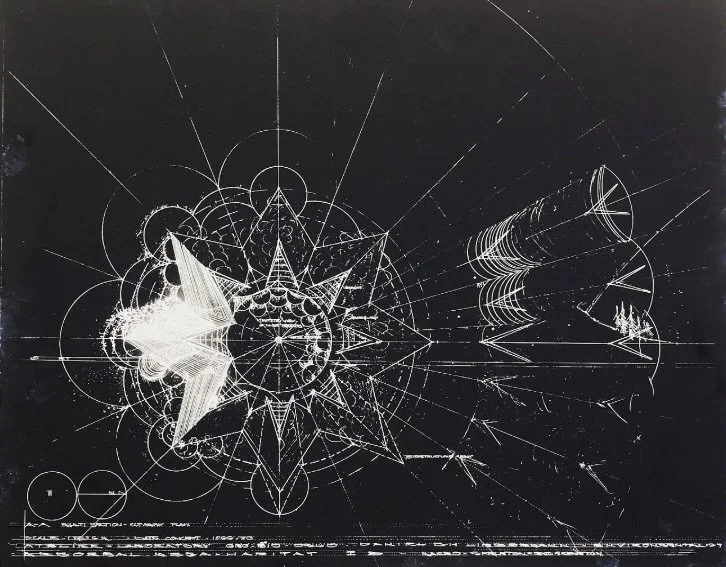
Liebermann’s houses are distinct: Always on a hillside, curving and radiating, anchored by central steel columns from which roof beams extend like sunbursts. Geometries that resist familiarity—never quite circular nor rectilinear—so the spaces appear different in different light. They extend outwards. It’s hard to say where they begin without telling a very long story and watching the incoming sky. “My plans begin not with an a priori housing concept,” Liebermann wrote, “but with an immediate and direct sensitivity to site.” He rejected square footage as a metric, working instead from land contour, sun, wind, fire, and the direction of fog, curves. The result was perception itself: “A truer understanding of how we see is the foundation of everything organic.”
From his bed, Liebermann later surrounded himself with books, shells, fabrics, typewriters, pipes, play cars, swords, and boats. He called it a collage—empathy—how the objects held stories, and related to one another, to the house, and to the landscape. “He approaches architectural problems as a landscape artist doing sculpture in the forest,” one critic commented in 1962. “But how rare, in the Bay Area, to find a building where a strong belief—any belief—is expressed.”
In building Pallas, I kept returning to the question of what gives a place its character. What makes it come alive? How does a space breathe—not only to hold art—but to invite thought, feeling, and instigate work? Imagination. Not questions that can really be answered, not apart from what in Greek was called aisthesis, the root of aesthetics—perception that is immediate, affective, reciprocal, and full. Taking in the movements of the ever-forming landscape, the collage of things around us, our responses as we move through a place, a conversation, a day.
Wood, which carries this story, and a certain ethos. And maybe, sometimes, the sea—crashing through the walls and crashing through the words.